Türkiye: What the drivers really said
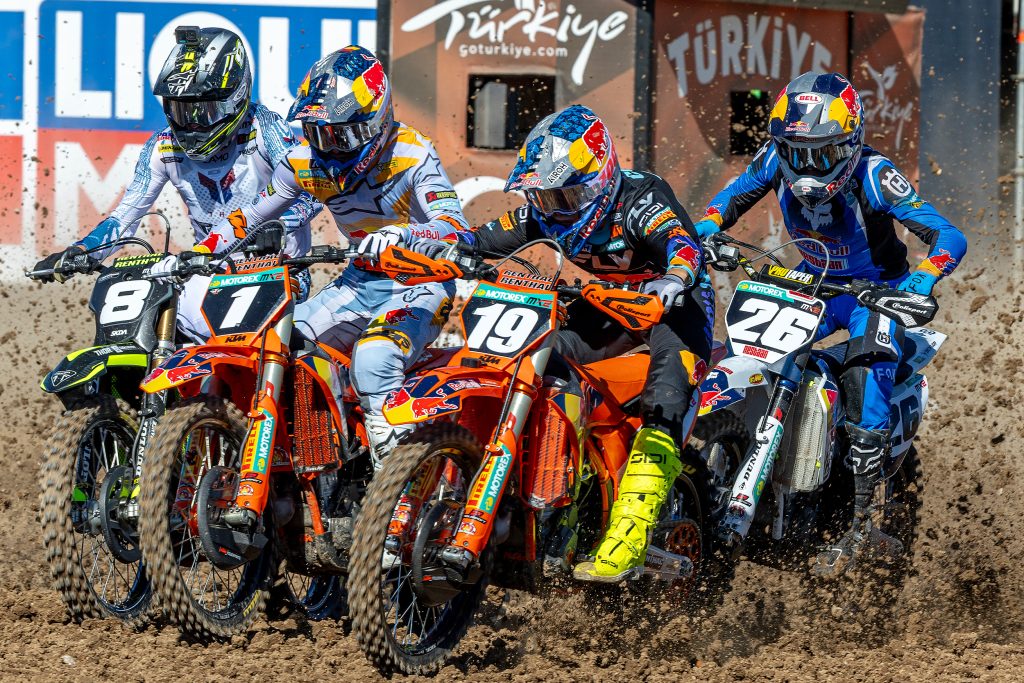
MX2 start at the 2026 Turkish MXGP. / Photo: Ray Archer
A world champion already talking about 2027. A Tom Vialle no longer satisfied with good MXGP results. A Romain Febvre who has quite clearly narrowed his problem down to the first 100 meters. And a Simon Längenfelder who, after weeks full of question marks, is suddenly winning again.
The Turkish MXGP provided ample material for a closer look at the riders' statements. While some things initially sound like a typical race weekend, they take on a completely different meaning in the context of recent weeks.
Herlings: The sixth title is clearly not the end for him.
Jeffrey Herlings didn't just win another Grand Prix in Afyon. With his sixth World Championship title, he capped off a season that at times certainly didn't look like it would end with him on top.
The fact that Tom Vialle kept him busy until the very end in the second race didn't make Sunday any easier. Herlings withstood the pressure, made no decisive mistakes, and did exactly what counts at this stage of the season. "Tom definitely didn't make it easy for me in the second race. But it was a great Grand Prix. Winning the GP, securing my sixth world championship title, and continuing my winning streak makes me very happy."
The really interesting part came next. "I'm already motivated to continue this in the last two races – and next year as well."
That doesn't sound like a driver who's going to switch off mentally after winning the title. On the contrary. Herlings is already connecting the current race with the upcoming season.
And that's precisely what might be even more unpleasant for the competition than the sixth title itself. The Dutchman doesn't currently seem like someone who has just reached a peak and then wants to take it easy. Rather, he seems to feel he's arrived back where he sees himself.
Vialle: One podium is no longer enough for him.
Tom Vialle's development is now clearly reflected in his choice of words. At the beginning of his return to Europe, it was inevitably about getting used to MXGP, the 450cc bikes, and the European tracks again. Now it sounds completely different.
Vialle wants to win.
In the second run, he stayed close to Herlings, waiting for the Dutchman to make a mistake. It didn't come. "I gave it my all in the second run to win, but Jeffrey simply didn't make any mistakes." The crucial point: Vialle doesn't mention being surprised at all that he was able to keep up with Herlings.
He had expected it. "I think I've shown that I'm close. We still have six races to win. That's my goal in China and Australia."
This significantly shifts his ambitions. A podium finish is no longer an exceptional reward for a good weekend. Vialle wants to take the next step.
He currently sees his biggest obstacle in the starts. His jumps out of the gate were good, but he still wasn't getting enough ground through the first few turns. Against a virtually flawless Herlings, that means having to work hard right from the start.
The first MXGP race win now seems less like a question of if than when.
Febvre: His problem begins before the actual race starts.
Romain Febvre's statement was one of the most interesting of the weekend because he described his situation with unusual clarity. He believes he is fast enough to win races, but his results don't currently reflect that.
"If I could start at the front, I could fight for the win. But with the starts I've had here again, I'm satisfied with third place."
Febvre doesn't see the problem as his race pace. He loses crucial time at the start and in the first few corners. After that, he begins a chase, the limits of which he also describes quite precisely. "By the time I get to third place, they're gone. The results don't reflect what I'm capable of."
And that's precisely the dilemma. Febvre can overtake slower riders. But once he catches up to opponents traveling at a similar speed, every position costs him significantly more time. Meanwhile, the riders at the front can maintain their lines and manage their lead.
Febvre is also indirectly saying that he has no doubts about the motorcycle or its fundamental speed. He simply needs to solve the race's first problem. Because no matter how fast a rider is for 30 minutes, if Herlings and Vialle already have a clear run at the front, a few fast laps won't be enough.
Gajser: The speed is back, but not the body.
Tim Gajser's statements must also be considered in the context of his physical condition. "Considering my current state, this weekend wasn't so bad. The speed was there, but I was riding in a lot of pain."
The crucial point is these three words: The speed was there.
Gajser had third place under control in the second run before going off the track and losing two positions. He then tried to attack again, made another mistake, and simultaneously noticed that the pain was getting worse.
So he finished fourth. Normally, missing the podium would hardly be satisfactory for Gajser. Under these circumstances, however, things look different.
His current problem isn't regaining speed. He needs to get into a physical condition where he can maintain that speed for an entire race.
The fact that he still speaks of a well-deserved podium finish shows how good his feeling must have been overall.
Fernández: A weekend in damage control mode
Rubén Fernández went into Sunday at a clear disadvantage after Saturday's incident. "I knew I simply needed a good start and then had to hold on as long as possible." That statement pretty much sums up his race day.
Fernández didn't plan when he could attack. He planned how long he could physically endure.
Under these circumstances, a result just outside the top ten takes on a different meaning. The goal wasn't to achieve the maximum sporting result, but rather to salvage as many points as possible from a weekend that was already damaged before the qualifying races even started.
Jonass: Good is no longer enough for him
Paul Jonass secured his third top-five finish of the season. At first glance, that sounds like a weekend to be satisfied with.
Jonass, however, is already looking ahead. "We still have some work to do to stay in the top four." That's a pretty accurate assessment. The Kawasaki rider has repeatedly shown that he can finish in the top five. This automatically shifts the benchmark. The question is no longer whether a fifth place is possible, but rather what's still needed to consistently put the riders ahead under pressure.
In Afyon, two good starts helped him to unleash his full potential. His statement also confirms what Febvre expressed much more clearly: In the current MXGP, the starting position after the first corner is extremely important.
Adamo: He now expects more from himself on the 450.
Andrea Adamo wasn't really satisfied with fifth place in the first race and his overall weekend. "Somehow this track didn't really suit me and I lacked the speed to keep up with the guys at the front. I should have been closer."
The last sentence is crucial.
Adamo no longer judges his 450cc races solely on the grounds of learning. He expects to be closer to the front. Just a few weeks ago, difficult sand races could be relatively easily explained by a lack of 450cc experience. Now, Adamo himself is becoming more demanding.
Afyon wasn't a good fit, neither in terms of riding technique nor in terms of feel for the motorcycle. That's precisely why he wants to work on a few things before China.
The learning process continues – but the protection afforded to puppies is apparently already over in his own mind.
Forato: The comeback nevertheless answered an important question
Alberto Forato's weekend was indeed bittersweet in terms of the result. However, the decisive part of his comeback happened in the first race. Seventh place.
“It was great to be back, even if the weekend was a bit bittersweet in terms of results. I had a really good race in the first heat, finished seventh, and felt comfortable on the bike.” With that, the most important question after his return was actually answered: Forato can immediately ride in the same range he would have been expected to ride before his break.
The second run, however, is difficult to assess meaningfully. According to him, the motorcycle was hit by a stone shortly after the start. The resulting problem prevented him from pushing normally.
Forato continued racing nonetheless. The result of the second race is therefore considerably less interesting than the insight gained from moto one: the basic speed is still there.
Talviku: The potential is visible, but stability is lacking.
With Jörgen-Matthias Talviku, one has to take a closer look, because the results alone make his weekend look pretty bad.
His first few laps were strong. In the first race, he was even in the top eight at the end of the first lap. Then he crashed heavily.
A similar thing had already happened to him in the qualifying race. The problem right now isn't necessarily getting up to speed in the first place. Talviku isn't yet able to maintain that pace throughout an entire race. "I'm not that used to these conditions yet, but I've learned a lot with the team over the past few weeks. Of course, I want better results, but these things don't happen overnight."
The last sentence is probably also a reminder to oneself.
After two early crashes, he lacked confidence in the last race. This is particularly costly for a rider in a new environment: instead of gaining further experience, he spends the crucial laps trying to rebuild his confidence.
Talviku is currently showing individual sections that look significantly better than his overall results. Now he needs to turn those into complete races.
Flanders: When "average" is already your own assessment
Calvin Vlaanderen didn't need many words after finishing ninth overall. "My driving in the races was average. I lacked the feeling I had yesterday." That sounds almost harsher than any outside analysis.
Vlaanderen apparently knew after Saturday that more would have been possible. That's precisely why ninth place isn't a result he can simply explain away with a difficult weekend.
The Ducati rider doesn't blame either the track or the motorcycle. He simply lacked feel for the bike on Sunday. Sometimes the analysis really is that simple – and yet so difficult to solve.
Längenfeld: This victory came at the right time
With Simon Längenfelder, it's worth looking back to Arnhem. After a disappointing weekend there, he explained that he felt he had already tried every trick in the book to get back into better positions.
A week later, he wins another MX2 race. “The past Grands Prix have been pretty tough for me, so this win felt good. I gave it my all in the first race, and it was my first win since Sardinia. That was a long time ago.”
This victory was therefore worth more than just 25 points. Längenfelder needed confirmation that he still had the pace to compete at the very front. After several races in which he himself had been searching for answers, he found them, at least partially, on the track in Afyon.
The second race, however, prevented a perfect weekend. He stalled his engine while in third place. After that, the positions were largely settled.
Second place overall is respectable. But for Längenfelder, what's probably much more important is having experienced again what it feels like to win a race.
Farres: Not just fast – but controlled
Guillem Farres' statement initially sounds relatively unspectacular. "In the second run, I had a significantly better pace than in the first and was able to control the lead until victory."
The word in particular check That made the difference. Farres didn't need to force the victory with a final attack. He had the speed, broke away, and was then able to react to the gap.
That's a different quality than a single fast run or a surprise victory.
Especially after the setbacks of recent weeks, Farres has shown that he is not only fast enough to be at the front. If his start and feel for the car are right, he can control a race from the front.
McLellan: An unusually sober border
Camden McLellan was also remarkably straightforward. "Third and fourth were the maximum today." For a driver with his ambitions, that initially sounds rather uncombative. In fact, it speaks more to a realistic assessment of his weekend.
Afyon is not one of the tracks where McLellan feels particularly comfortable. On Sunday, his feeling was better than the day before, but he still lacked a bit of pace to get to the front.
Instead of making a big deal out of it, he accepted the points. That can be quite valuable at this stage of the season. You can't force a win every weekend.
McLellan apparently sees China and Australia as better opportunities to get more out of himself again.
Sacha Coenen: This time the race was secondary.
Just a week earlier, Sacha Coenen had sounded quite combative after Arnhem. Understandably, none of that remained in Turkey. "I can be glad I wasn't injured in that crash. A weekend to forget, and we'll try again."
Coenen wasn't feeling well that morning. He was having trouble concentrating and focusing his gaze. Under these circumstances, the hard fall was almost a logical warning that not much was going to go right for him that day.
That he remained uninjured was more important than any result. Therefore, Afyon shouldn't be overvalued in his case. It was less a sporting setback than a weekend where the rider and the track never really clicked.
Janis Reisulis: Lots of speed, but still too many missed opportunities
In Janis Reisulis' case, the results list hardly shows what would actually have been possible.
In the first race, he crashed in the first lap but then fought his way back from last place to sixth. "My speed and intensity were really, really good." Given this comeback, that's no exaggeration.
In the second race, however, there was another crash in the first lap. This time the clutch lever broke. Because Reisulis was unable to restart the motorcycle without assistance, he was disqualified. "I know I have the speed and that everything is there."
But that's precisely where his current problem lies. The speed is there. It just needs to be converted into a complete result more often. Two crashes in the first lap of the same race day can no longer be chalked up to bad luck alone. Reisulis now needs to combine that speed with the necessary composure in the opening minutes of the race.
Karlis Reisulis: This time it wasn't the motorcycle's fault.
Karlis Reisulis was also quite self-critical in his assessment. "I had problems this weekend and didn't feel like myself at all on the motorcycle."
In the first race, he admitted to lacking concentration. Mistake followed mistake. Remarkably, he didn't try to blame the team or the motorcycle.
The second run was better, but not good enough to make a decisive move forward. His conclusion is therefore fitting: "It wasn't a weekend I can be proud of, but definitely one I can learn from."
For Karlis, the goal before China isn't so much to reinvent the motorcycle. He needs to rediscover the feeling that usually defines him.
Karssemakers: Good starts suddenly change the whole weekend
Kay Karssemakers summed up his relief perfectly in his first sentence: "Finally, two good runs in one day." After several setbacks, this is more important to him than it might initially sound.
Karssemakers doesn't see his basic pace as a problem. Rather, his statement shows how much his results depend on whether he's in the right part of the peloton early enough.
This time he managed two decent starts. Suddenly he was able to show what he was capable of. In the first run, a small crash while attacking Julius Mikula cost him several places. In the second, he quickly worked his way up from seventh to fifth. Even a period of arm pump didn't completely throw him off his rhythm.
For him, Afyon was therefore primarily a confirmation: if the starting position is right, he belongs further ahead than some of his past results would suggest.
The statements tell more than the results list.
Afyon was a good example of why driver statements become more interesting when they are not simply read as a retrospective description of the races.
Immediately after his sixth world title, Herlings is already talking about carrying his momentum into next year. Vialle no longer sees a strong second place as a success in itself, but as proof that his first victory is within reach. Febvre is convinced that it's not his speed, but his start that's preventing him from achieving better results.
In MX2, Längenfelder finally received confirmation of a race win after weeks of searching. Farres showed that he can not only win a race, but also control it. And with Janis Reisulis, it's becoming increasingly clear that speed isn't his problem at the moment – but rather reliably converting it into results.
The situations vary. Some riders lack speed. Others lack health, starts, consistency, or simply confidence. And what about Jeffrey Herlings? He's just won his sixth world championship title – and yet he already sounds like the next goal is more important to him than the one he's just achieved.