
MXGP breaks the million mark – but who's watching?
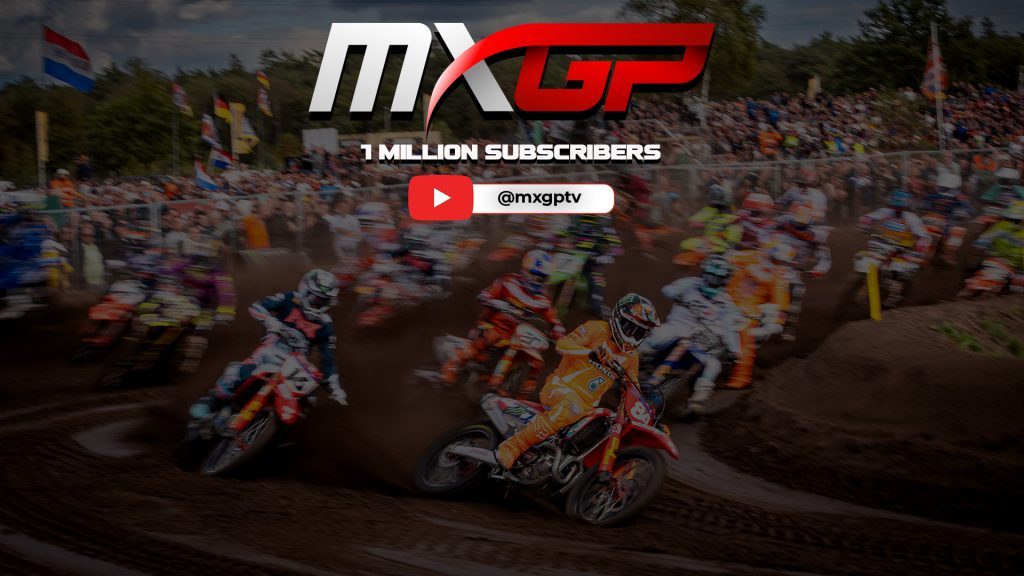
MXGP has surpassed 1 million subscribers on its YouTube channel. / Photo: IMR
How much are a million YouTube subscribers worth if many new videos barely reach 5.000 views?
Infront Moto Racing is celebrating a digital milestone at the MXGP of Türkiye. The official YouTube channel of the Motocross World Championship has surpassed one million subscribers. Just twelve months ago, it had 700.000 subscribers. Within a year, this represents an increase of approximately 300.000 subscribers – a growth of almost 43 percent.
For a sport like motocross, that's undoubtedly a remarkable number. This makes the channel one of the most popular digital platforms within the scene. However, a closer look at the individual videos reveals a significant discrepancy between the channel's size and the actual engagement with much of its content.
One million subscribers is not the same as one million viewers.
The MXGP channel has existed since April 2013. During this time, almost 11.000 videos have been published and a total of around 270 million views have been collected. The one million mark is therefore initially a total number that has grown over many years.
Many subscribers likely discovered the channel through older videos. Among the most successful releases are the 2013 Motocross of Nations with over eight million views, duels between Jeffrey Herlings and Antonio Cairoli, and footage featuring Tim Gajser, Jorge Prado, and Ryan Villopoto. Some of these videos are from a completely different era of the World Championship.
Some of these subscribers will no longer be active today. Others are only interested in spectacular duels, crashes, or the actual race summaries. Then there's the international focus. A fan who subscribed because of Cairoli and Italian content isn't automatically going to click on an English EMX125 summary or a half-hour press conference.
Therefore, the number of subscribers says little about how many people each new publication actually reaches.
The race summaries are working.
However, there is no general problem with reach. The comprehensive MXGP and MX2 summaries continue to be in high demand.
News highlights from Argentina reached approximately 364.000 views this season. The Czech Republic garnered over 286.000, Sweden around 163.000, and the Netherlands about 173.000. Qualifying summaries also regularly achieve between 70.000 and 110.000 views.
So there is interest in the actual racing action. Anyone who wants to see the most important moments from MXGP and MX2 in a roughly ten-minute video is taking advantage of this offer.
It becomes significantly more difficult with the secondary formats. Studio shows, track presentations, press conferences, individual race scenes, and the various language versions often remain in the low four-figure range. Among the longer videos released most recently, the average was not even 5.000 views.
Measured against one million subscribers, this equates to less than 0,5 percent.
Too many videos in too short a time
One reason for this can already be seen in the release schedule. On Saturday of the Turkish GP, the studio show, training summaries from MX2 and MXGP, as well as videos of EMX125, EMX250 and qualifying were released within just a few hours.
At the previous Grand Prix in the Netherlands, in addition to race summaries, the channel published numerous individual segments, interviews, press conferences, an FPV round, and multiple language versions. Shorts were also released.
This means that every new MXGP video competes with other releases from the same channel.
YouTube sends a maximum of three video or live stream notifications from a channel within a 24-hour period. If more than three videos are published within a short time, the platform may even temporarily stop notifications altogether.
Someone who publishes six videos in one afternoon won't reach their million subscribers six times. Some of the videos appear without notification, while the remaining posts compete for the same viewers.
While the sheer volume makes the channel an extensive archive, it doesn't necessarily help with the reach of each individual post.
One channel for too many target groups
Infront describes the channel as the digital home of the Motocross World Championship. In terms of content, that's accurate. MXGP, MX2, WMX, EMX250 and EMX125 are all represented, as well as "Behind The Gate" content, rider profiles, podcasts, interviews and exclusive footage.
However, this very diversity becomes a problem on YouTube.
An MXGP fan isn't necessarily interested in the EMX. Those looking for short race highlights don't necessarily want to watch a podcast lasting over an hour. Furthermore, there are French, Spanish, Italian, and Indonesian versions of similar videos, some of which only reach between 1.700 and 3.600 views.
YouTube uses previous viewing behavior to determine which videos are recommended to a user. If a subscriber ignores several videos in a row because the language, genre, or format doesn't match their preferences, the likelihood of the next video being prominently displayed decreases.
Separate channels for specific languages or greater use of different audio tracks could relieve the main channel. Currently, almost all content ends up in the same feed.
“Behind The Gate” with a conspicuous break-in
The discrepancy is particularly evident in the documentary series "Behind The Gate". The first episodes of the 2026 season achieved some enormous viewership numbers. Episode 1 garnered around 571.000 views, episode 5 544.000, and episode 7 332.000. However, the picture changed abruptly from episode 10 onwards.
Episode 10 only reached about 11.000 views, while episode 11 remained just under 10.000. Episodes 13 to 16 mostly landed between 10.000 and 19.000 views. Only episode 12 jumped to around 184.000 views.
Even more striking is the ratio between views and reactions. Episode 5 garnered only 734 likes out of more than 544.000 views. That equates to roughly 0,13 percent. Episode 12, with 184.000 views, received a mere 249 likes.
The significantly weaker episodes, on the other hand, achieve like rates of approximately one to 1,5 percent. Episode 10 received 138 likes out of 11.000 views, while episode 16 received 126 likes out of roughly 11.000 views.
This suggests that some of the high-reach episodes were also distributed via paid video advertising, automatic embedding, or other external sources. YouTube includes certain views generated through ads in its publicly visible view count. Whether this was actually the case with "Behind The Gate" cannot be definitively proven without access to the channel's internal data.
However, the figures suggest that the series' current organic reach is more likely between 10.000 and 20.000 viewers. The earlier six-figure viewership numbers would therefore not be a suitable comparison for today's episodes.
Good contents, weak packaging
The titles don't always make things easy for the videos either. Labels like "Welcome", "Postcard", "News Highlights" or "The Rocky Road" hardly reveal what story the video contains.
Anyone reading "Behind The Gate – Episode 16 – The Rocky Road" will learn neither which driver is the focus nor why 26 minutes should be worthwhile. The series title is known, but the specific content remains a mystery.
The situation is different when stars and sporting conflicts are already featured in the title. The duel between Jeffrey Herlings and Kay de Wolf in Arnhem garnered around 38.000 views. An interview with Chase Sexton about sand racing, Herlings, and de Wolf reached approximately 34.000 views.
Famous drivers alone don't guarantee reach. However, they give viewers a clearer reason to click on a video than a generic episode title.
The celebrated milestone is real. One million subscribers gives the World Championship a strong starting position and shows that motocross can reach a large international digital audience.
However, the publicly available figures clearly show that Infront has so far only tapped into a portion of this potential. The race summaries are successful, but many other formats get lost in the sheer volume of content. The channel is large – its active audience is considerably smaller, depending on the content.