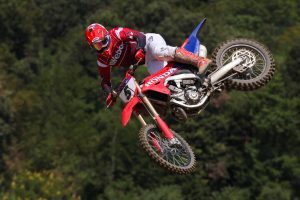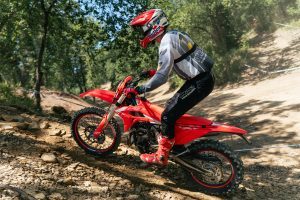
Kove MX250R review: A lot of motorcycle for little money

We tested the Kove MX250R for you. / Photos: Kai Brake
Chinese motocross bikes still have a clear image in the paddock: cheap, but with question marks regarding quality, durability, and support. With the Kove MX250R of the year 2026 The focus is precisely on such a bike – but with an approach that deliberately aims to stand out from classic cheap copies.
The price directly sets the framework: Round EUR 6.500 for a new 250F. This puts Kove significantly below the level of established manufacturers like KTM, Husqvarna, Yamaha or Honda.
The crucial question, therefore, is not whether it is cheap. But whether it works – and for whom.
Small brand, big ambitions
Kove is not a complete newcomer. The brand has been active for several years and has made a name for itself, particularly in the rally and adventure segments. Dakar entries with multiple bikes finishing the race are not a marketing gimmick, but a clear signal: the technology is fundamentally reliable.
The situation is different in the motocross sector. The MX250 was introduced in 2022, and the second generation – the MX250R – is now on the market. In Europe, especially in Germany, its distribution is still limited. Current estimates suggest there are around 50 bikes in circulation.
Test under real-world conditions
For MXNEWS Online The Kove MX250R was developed by Sebastian “Busty” Wolter Tested under real-world conditions. No test bench, no laboratory – just classic track use. MSC Oberes Weisstal eV At motocross level. That's exactly where it's decided whether a bike works.
The approach was clear: An honest driving impression without long-term predictions, but with a focus on what drivers are really interested in in everyday life – handling, engine characteristics, chassis and overall impression.

Technology and basics: More substance than expected
In Germany, the Kove MX250R is only available as the "Factory Edition". This model comes standard with features that are not typical in this price range: KYB suspension, milled triple clamps, reinforced components, Titanium exhaust and a mapping switch on the handlebars.
The key data is also within the usual range:
- 1490 mm wheelbase
- 28-degree steering head angle
- 310 mm ground clearance
- 960 mm seat height
- approximately 103 kg ready to ride
Even in the second generation of the motorcycle, a steel frame forms the basis of the chassis. The turquoise bodywork has a unique design and offers good freedom of movement as well as clean contact surfaces. Brakes They are from Taisko; the front brake disc has a diameter of 290 mm, the rear one 240 mm.
The two available Mapping The two mappings differ noticeably and can be switched while riding using handlebar switches. The Sport mapping is more direct, aggressive, and revs more freely. The Eco mapping is more responsive but remains powerful enough for brisk riding.
Interestingly, even in "Eco" mode, the bike doesn't feel sluggish. It remains rideable and still allows for high speeds – a point that stood out positively in the test.
The Quickshifters It works reliably and in some cases even more smoothly than with some established manufacturers. This is a real advantage, especially in fast sections or when shifting up under load.
Engine: Independent, but not exotic
The Kove MX250R is powered by a completely new engine from the manufacturer Loncin, which also produces for BMW, among others.
The 250cc four-stroke engine is an in-house development with a DOHC design and four valves. Bore and stroke are 79 x 51 mm, and the compression ratio is 13,9:1. A Bosch fuel injection system handles the mixture preparation, and the power output is rated at approximately 30 kW (41 hp), which is transmitted to a 5-speed gearbox.
In practice, the engine delivers exactly what you would expect in this class: easily controllable power.

Chassis: Clearly designed for hobby drivers
The Factory Edition features a 48 mm KYB SSS fork with 310 mm of travel and adjustable compression and rebound damping. At the rear, a YU-AN shock absorber, whose internals and spare parts are identical to Showa components, provides 280 mm of travel. Rebound, as well as high- and low-speed compression, are adjustable.
Limits become apparent in border areas:
- hard braking bumps
- large jumps (in the range of 20–25 meters)
- fast, aggressive lines
Here the suspension becomes noticeably softer and begins to work. It doesn't bottom out completely, but reaches the point where ambitious drivers would make adjustments.
However, this is not unusual behavior. Many production motorcycles are similarly tuned from the factory and are only adapted to higher demands through individual setup. An experienced suspension tuner should have no problem adjusting and optimizing the KYB fork and shock absorber.
On the route: Surprisingly inconspicuous
Perhaps the most important impression to get straight to the point: The Kove MX250R works. Engine, brakes, clutch, ergonomics – everything does what you'd expect. There are no serious malfunctions, no uncontrollable reactions, no real weaknesses that immediately jump out at you. The bike is intuitive to ride. Get on, ride off, get comfortable – without any lengthy adjustment period.
Character: More conservative than modern
In direct comparison to current top models, it's noticeable that the Kove isn't quite up to date with the latest developments. The riding experience is more reminiscent of motocross bikes from the 1980s. 2015 – 2018Less aggressive, less playful, less extreme in geometry.
However, this is not automatically a disadvantage.
On the contrary – many riders feel comfortable at precisely this level because the bike remains stable and predictable, rather than being hyper-agile. You could say: less high-end, more accessibility.
Spare parts and dealer network: The biggest uncertainty factor
The most critical point is not the bike itself, but the surrounding environment. The dealer network is currently still being established. There are individual contacts in Germany, such as... Eljoo Bikes and BSN-Racing, who provided us with the MX250R, but do not have a comprehensive structure like the major brands.
Spare parts are generally available. Wear parts can sometimes be replaced with existing components from other manufacturers – for example, individual parts from Honda or brake pads from Nissin will fit.
Value for money: The key argument
Ultimately, price remains the biggest factor. For around €6.500, you get a motorcycle that comes close to the established competition in terms of functionality. The difference in riding feel is there – but not as significant as many would expect.
From a purely mathematical perspective, it's interesting: For the price of a new 250F from a premium manufacturer, you can get almost two Kove bikes – or one bike plus a comprehensive spare parts package. This puts many of the existing risks into perspective.
For whom does the Kove make sense?
The Kove MX250R is not a bike designed for direct, top-level racing. Those aiming for the front of the pack in the ADAC MX Youngster Cup or internationally will continue to opt for established brands.
But:
For hobby riders, beginners, or those competing in regional series, this bike is a real option. Especially in the amateur ranks, a clear picture emerges: around 80–85% of riders are likely to reach their own limits faster than the motorcycle's. The Kove performs very well precisely in this range.
Conclusion
The Kove MX250R It's not a game-changer – but it's a serious contender. It works, is solidly equipped, and delivers a level of performance that's perfectly adequate for a large portion of drivers. The differences compared to the top competitors are there, but not as significant as the price difference might suggest.
The open questions lie less in the product itself, but in the surrounding environment: dealer network, spare parts supply, long-term experience.
Those who are willing to embrace this will get a motorcycle that is closer to the established competition than the label "China-Bike" would suggest.