
A journalist's life: 24 hours on the road for two days of MXGP
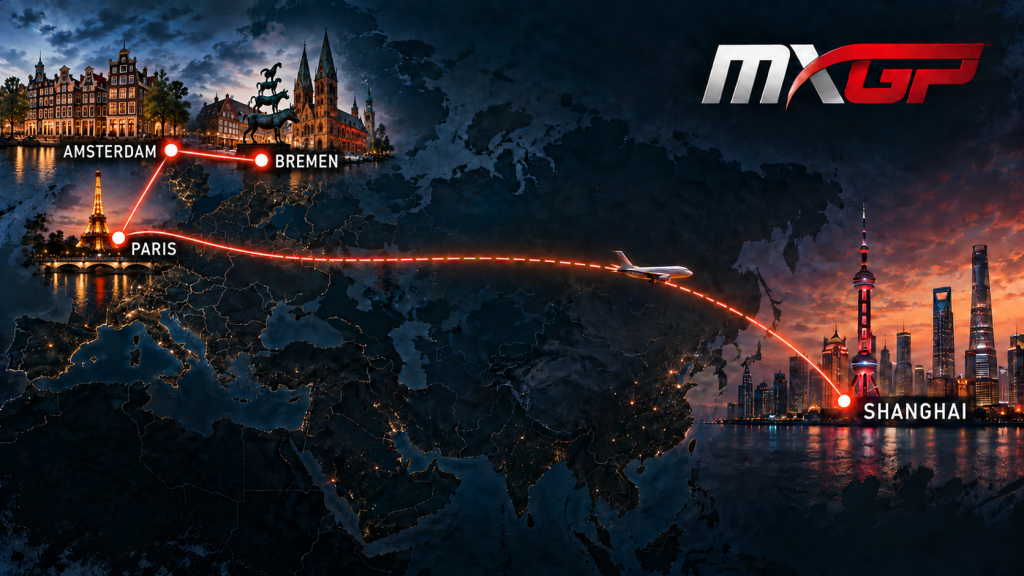
Itinerary for the 2026 MXGP of China. / Image: AI
How much travel is actually involved in an MXGP weekend on the other side of the world? Yes, I travel the world with the Motocross World Championship. Not to every Grand Prix, but regularly enough to know that the work on the track is often only a small part of the story.
2026 was still meant to be something special. With China and Australia on the calendar at the end of the season, there were two overseas races I didn't want to miss. Two Grands Prix, two continents, and in between, a week that, even during the planning stages, raised the next question: What am I actually going to do between Shanghai and Australia?
Flying home? Makes little sense. Staying in China for a week? Possible. In the end, the decision was made to go to Singapore. If you're already on this side of the world anyway, you might as well have a look around.
But before that can happen, I first have to get to Shanghai.
Bremen, Amsterdam, Paris, Shanghai
The journey begins in Bremen. From there, my first flight takes me to Amsterdam, then on to Paris, and only then does the really long part towards Shanghai begin.
On the map, it all looks quite straightforward. In reality, it means airports, security checks, searching for gates, changing planes, waiting, getting back on board, and eventually completely losing track of what time it actually is.
In the end, there are around 24 hours travel timeFor an event that only lasts two days. That sounds pretty ridiculous at first. And if you compare the effort involved with the actual time spent at the racetrack, it probably is a bit.
But that's exactly what makes this job so cool.
Going to an MXGP in Europe is relatively straightforward. Pack the car, drive for a few hours, pick up accreditation if needed, and head to the paddock. An overseas GP is a different story. Cameras, lenses, laptop, and everything else needed for a full race weekend have to be packed and flown. Add to that the usual suitcase for almost three weeks on the road.
And you shouldn't forget anything if possible. A missing charging cable can usually be replaced somehow. Camera equipment is a different story.
Two days of racing, but much more than two days of work.
From the outside, you later see the pictures, articles, and interviews from the weekend. What you don't see are the hours before and after.
For Shanghai, this means spending a whole day traveling, somewhere between Amsterdam and Paris no longer knowing exactly which coffee was which number, and arriving in China in a reasonably good condition after several flights.
Because the schedule doesn't wait for me to have jet lag.
That's precisely what makes this trip so interesting. I'm not flying to China for a two-week vacation, but for a motocross grand prix. Nevertheless, this job is taking me to places I probably would never have otherwise visited.
Shanghai is just the beginning.
After the Chinese Grand Prix, it's not back to Germany, but on to Singapore. A few days out of the paddock before the next and final overseas Grand Prix of this trip awaits in Australia.
Almost three weeks on the road for two race weekends.
Is all this effort worthwhile?
I probably won't answer that quite so enthusiastically after the third airport at the latest. But that's precisely why I want to document this trip in more detail this time – not just what happens on the route on Saturday and Sunday.
But also all the stuff surrounding it.
Denn 24 hours travel time for two days of motocross This is actually a pretty fitting first episode of my journey to the last two overseas races.