Honda CRF450R 2027 review: More power, less weight
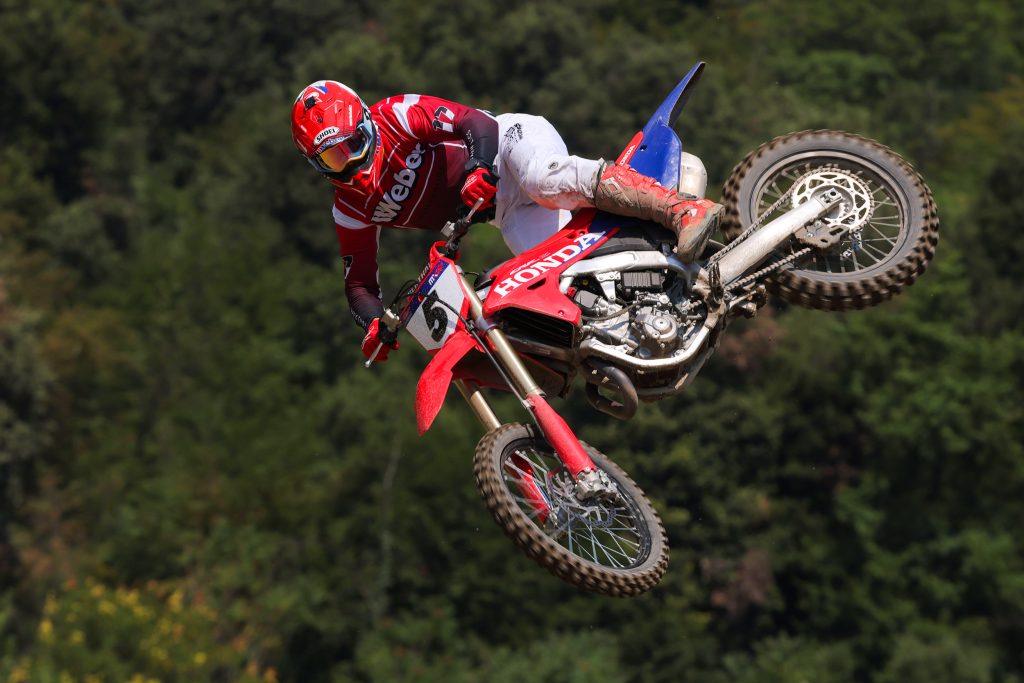
Sebastian Wolter tests the new 2027 Honda CRF450 for MXNEWS Online. / Photo: Zep Gori
Honda isn't waiting for the usual model cycle with the CRF450R this time. Just two years after the last major overhaul, the next big step is already coming in 2027. Under the development motto "Kiwami" – roughly translated as the ultimate overhaul – the Japanese manufacturer has reworked the engine, transmission, clutch, frame, swingarm, and suspension.
On paper, one thing stands out above all: around ten percent more peak power, almost four percent more torque, and four kilograms less overall weight. The engine alone has been modified to save around 2,7 kilograms. According to Honda, this makes the new CRF450R the manufacturer's lightest 450cc motorcycle since 2009.
Sebastian Wolter was able to test the new Honda on the GP circuit in Arco di Trento. Although the day was physically demanding at 37 degrees Celsius, the track itself, with its tilled and well-watered surface, presented itself in almost perfect conditions.
Engine: More power, but above all, more versatile
Honda's goal with the new engine wasn't solely to increase peak power. The torque needed to be available across a wider range, while improved throttle response and drivability were also key objectives.
This involved overhauling components such as the valves, cylinder head, pistons, intake system, air filter, and crankshaft. The clutch and gearbox are also new.
The gearbox makes its presence felt quickly on the track. The individual gears overlap more than in the predecessor. Strong acceleration out of tight corners is possible in second gear, and if the distance to the next corner is too short for another shift, the gear can simply remain engaged.
The engine revs freely and continues to pull strongly even at high RPMs. There are no unpleasant vibrations. Similarly, the Honda can be easily driven out of corners in a higher gear. A little clutch assistance is all it takes to accelerate powerfully again.
At the very bottom end, the new CRF450R seems to have lost a bit of torque compared to its predecessor. This was also noticed by other test riders who are familiar with both generations. Overall, however, the engine remains very rideable and offers a remarkably wide usable rev range.
Three mappings with noticeable differences
Honda offers three pre-programmed engine mappings: Standard, Soft, and Aggressive, selectable directly via the handlebar-mounted switch. There is no smartphone app for customizing the mapping. Three-stage traction control and launch control are also included.
All three mappings differ significantly from each other on the track. Even the standard setting delivers ample power and works well under normal conditions.
As the track became more worn throughout the day, and Sebastian's own energy began to wane in the 37-degree heat, he found the smoother engine mapping to be the most comfortable. This resulted in a softer throttle response without any subsequent loss of power. When the throttle was opened, the Honda continued to pull strongly. Even the big jumps on the GP circuit were easily manageable.
The aggressive mapping significantly increases the power delivery. This setting might be the right choice for deep sand or experienced racers. However, under the grippy conditions at Arco, the added sharpness was hardly necessary.
The most pleasant combination was the gentle mapping and traction control set to level one. This kept the power easily controllable and required significantly less clutch use.
Chassis: Less nervous, yet still manageable
The chassis also saw significant changes. Around 70 percent of the frame was redesigned. This includes a newly constructed swingarm that is eight millimeters longer and has a modified shape. The wheelbase and trail were also adjusted.
On the track, the CRF450R exhibits a slightly different character than its predecessors. It no longer leans quite as readily into tight corners, but gains noticeably in stability.
It remains manageable nonetheless. Tight lines can be entered without much effort, and even corrections within a corner are possible. If the motorcycle initially drifts slightly wide, the line can be adjusted inwards again without having to fight against the Honda.
The added calmness is particularly noticeable at higher speeds. Other test drivers with extensive experience on previous CRF models also noted that some of their former nervousness had disappeared.
Honda has thus traded some of the extreme agility for more stability, without making the CRF450R cumbersome.
Stiff standard suspension with good reserves
For 2027, Honda is pursuing a new tuning philosophy for its Showa suspension. Instead of aiming for minimal friction across the entire suspension travel, the goal is now to achieve optimal friction at all times. The suspension is designed to be sensitive at the beginning of its travel and offer sufficient control deeper within the travel.
The basic suspension setup is rather firm. This suits the character of the new Honda well, especially at higher speeds.
Even with some slightly over-bounced landings, there was still plenty of margin for error. Only on really big impacts did the landing gear reach its limits. A hard bottoming out was never an issue.
As the track became increasingly worn, the fork and shock absorber continued to perform flawlessly. The balance between the front and rear wheels is excellent and contributes to the more stable character of the new chassis.
Well balanced even in the air
The balanced handling isn't just evident on the ground. The CRF450R also behaves neutrally over the larger jumps at Arco.
The motorcycle responds well to weight shifts, can be whipped or scrubbed, and changes of direction in the air are also easily achieved. Neither the front nor the rear wheel feels dominant.
Especially on a track with many and sometimes large jumps, this neutral behavior provides additional confidence.
New clutch reduces engine braking
One of the most technically interesting changes is found in the clutch. Honda spent three years developing the new concept. Three rubber elements and three pistons create an effect similar to a slipper clutch. This is intended to reduce engine braking and make the CRF450R feel more responsive when braking and cornering.
The engine braking is indeed pleasantly minimal. However, under the conditions in Arco, it was difficult to determine how much of this was due to the new clutch system. The soft ground already slowed the motorcycle down considerably.
There is one point of criticism regarding the controls. After a few laps, the clutch felt somewhat stiff. Less effort required at the lever would be desirable, especially over longer race distances. The clutch's function itself was flawless.
Ergonomics without surprises
The bodywork was also revised, and the seat was made slightly flatter. Despite his height, Sebastian could move around the motorcycle without any problems. Switching between sitting and standing works well, and there is also plenty of room far forward on the motorcycle.
There's little to criticize about the controls. The brakes work smoothly and unobtrusively, and the throttle and other controls also give no cause for complaint.
Visually, Honda is returning more strongly to the classic red and blue combination. Many plastic parts are now made from recycled material. The aluminum tank has been slightly enlarged and now holds just under 7,1 liters.
It has become quieter, without sounding constricted.
Another change becomes apparent after just a few laps: The CRF450R is comparatively quiet.
Honda has optimized the new exhaust system to meet the stricter noise regulations. The reduced noise level is clearly noticeable on the track, without the engine feeling restricted or experiencing a noticeable loss of power at higher RPMs.
Conclusion
Honda has made the right improvements to the CRF450R for 2027. Four kilograms less weight and ten percent more peak power sound good, but other changes are more noticeable when riding.
The new gearbox reduces unnecessary gear changes and allows for more flexibility in gear selection. The engine revs high but can also be driven in a higher gear. The three mappings differ significantly enough to offer a real benefit depending on the track, road surface, and the rider's own condition.
The new chassis balance is particularly successful. The CRF450R has lost some of its extreme agility, but in return, it feels calmer and more stable at higher speeds. Tight lines can still be easily hit, and even subsequent line corrections can be made without much effort.
The firm Showa suspension suits this character well and offers ample reserves even for hard landings. The main criticism is the somewhat stiff clutch. Riders switching directly from the previous model might also notice the slightly lower torque at the bottom end.
Overall, the 2027 CRF450R isn't just lighter and more powerful. Above all, it feels more balanced. This added composure, without completely sacrificing typical Honda handling, makes the biggest difference on the track.