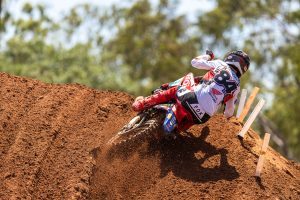
The engine of Brian Hsu's JHL MX350
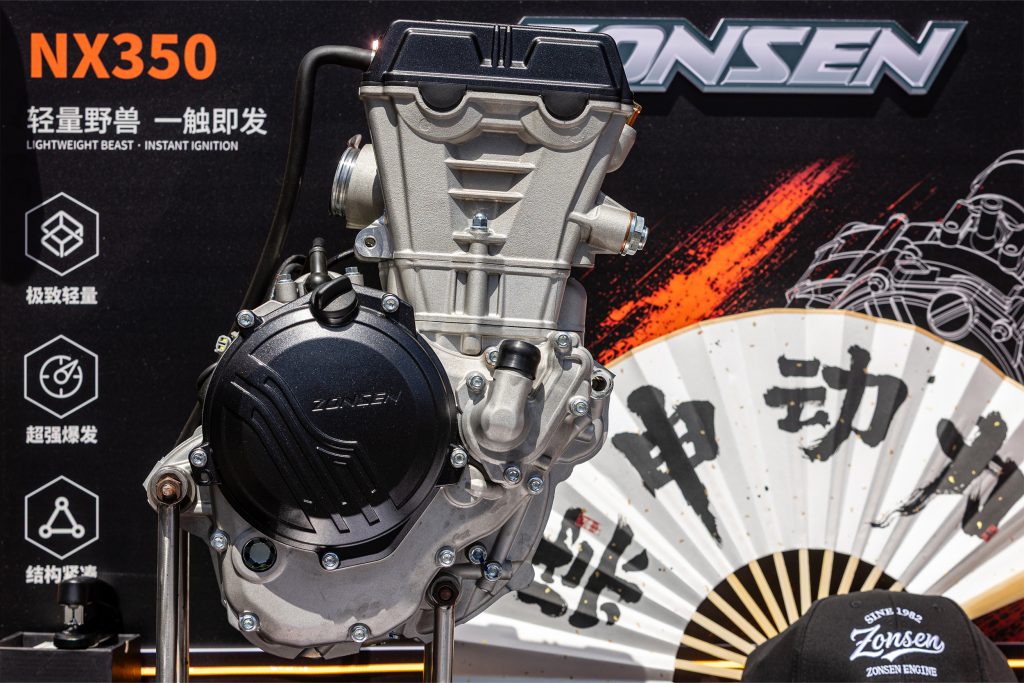
The engine that's in Brian Hsu's JHL MX350
What exactly is under the hood of the JHL MX350, with which Brian Hsu will contest the Chinese brand's MXGP debut this weekend? The technical documents confirm what the model designation suggested: The JHL is powered by a 349,7 cc engine.
The engine, internally designated ZS188MP, comes from Zonsen Power in Chongqing. It is a liquid-cooled, four-stroke, single-cylinder engine with dual overhead camshafts, four valves, and a balance shaft. Its original application is in the enduro sector, as Daniel Hu, Sales Director of JHL, informed us.
The bore and stroke are 88 and 57,5 millimeters respectively. The engine is therefore a short-stroke design. The compression ratio is specified as 13,0:1.
Approximately 45,5 hp at 9.500 rpm
According to the data sheet, the standard engine achieves a maximum output of 33,5 kilowatts at 9.500 revolutions per minute. This corresponds to approximately 45,5 hp. The maximum torque is specified as 36 newton meters at 8.500 revolutions per minute.
These stock figures are particularly interesting for Hsu's MXGP start: According to his father, no modifications were made to Brian's engine. The previously open question of whether performance could have been increased through engine modifications is therefore moot. However, we do not have any measurements of the specific race bike.
The power curve shows that the engine develops its power primarily through engine speed. Power increases significantly from around 6.500 rpm. Torque reaches its peak between 8.000 and 9.000 rpm, before both curves decline slightly again towards 10.000 rpm.
Six-speed gearbox and electric start
Power is transmitted via a six-speed gearbox. A cable-operated, wet multi-plate clutch is fitted. The engine is started electrically. According to the manufacturer, lubrication uses pressure and splash lubrication.
With dimensions of 372 × 279,5 × 423 millimeters, the unit is compact. Its stated net weight is 28,8 kilograms. The manufacturer points to a newly developed engine housing and the lightest possible construction of the individual components.
The balance shaft is designed to reduce vibrations. In motocross, this can relieve stress on the rider and reduce wear and tear on the frame and components.
The 350 as a first step
Competing against established MXGP machines with a standard 350cc engine is an unusual decision. However, Antonio Cairoli demonstrated that this engine size can fundamentally work at the World Championship level: he won several of his Motocross World Championships on the KTM 350 SX-F.
Meanwhile, modern 250cc four-stroke motorcycles have gained in power, while 450cc bikes dominate the MXGP class. KTM and Husqvarna, however, are sticking with this engine size with their 350 SX-F and FC 350 respectively.
JHL is already working on the next stage. As Hu informed us, a 450cc engine has been undergoing testing for some time. The brand intends to use it at the Chinese Grand Prix next year. The race is scheduled to take place in May 2027.
For Hsu's premiere, the focus is therefore on the overall package: What can the JHL MX350, with an unmodified production engine, do against the competition's machines specifically developed for racing?