Bonnell CEO Matt Wauters: Will the next generation drive electric?

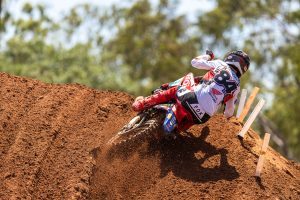
Bonnell CEO Matt Wauters in conversation with Josh Hill. / Photo: Bonnell
Are we seeing a generation of riders who will one day no longer take a motocross bike with a combustion engine for granted?
Anton Wass has long held this view. The founder of Stark Future sees electric drive not simply as an alternative to the combustion engine, but as the long-term future of the motorcycle. He is no longer alone in this opinion within the industry.
Matt Wauters, founder and CEO of Bonnell, arrives at a very similar conclusion when developing his own dirt bikes. He argues less in terms of environmental regulations or a potential end to the combustion engine. For him, it's primarily about performance, technological development, and a generation of riders who are growing up with electric motorcycles.
This last point is particularly interesting. Wauters expects that many children who are currently taking their first rides on an electric 50cc motorcycle will also find an electric alternative when they later switch to larger motorcycles.
Bonnell apparently wants to be one of the manufacturers who provide them with these motorcycles.
Bonnell comes from a different background.
Wauters and Bonnell did not follow the traditional path of a motorcycle manufacturer. Before developing complete motorcycles, Wauters focused on high-performance electric drives and the conversion of existing e-bikes.
It seems that this period in particular shaped his current view of technology.
Early electric racing quickly revealed that more motor power alone doesn't make a better motorcycle. Wauters reports on modified bikes where the power output eventually reached levels for which the original chassis wasn't designed. Swingarms warped under load, chains jumped off, and individual components reached their limits.
You can always upgrade the motor, controller, and chassis. If the base wasn't built for that, then that very base will eventually become the problem.
Bonnell drew a fairly clear conclusion from this and began developing its own platforms.
This also distinguishes these motorcycles from attempts to cleverly rebuild an existing combustion engine frame around a battery and electric motor. Wauters believes this approach is fundamentally possible, but sees advantages in starting with a blank sheet of paper when developing an electric motorcycle.
Bonnell's own motorcycle history begins with the 805.
The first result is the Bonnell 805It's more compact than a classic full-size cyclocross bike, and its dimensions are closer to those of an 85cc bike. However, its performance tells a completely different story.
This is precisely part of the idea behind the motorcycle. The power output of an electric drive can be largely adjusted electronically to the rider and the intended use. A motorcycle can therefore provide significantly more power than its rider actually uses.
Josh Hill shows how far this can go.
The former Supercross pro is working with Bonnell on the development of the motorcycles. Although the 805 offers five different power modes, according to Wauters, Hill himself doesn't permanently use the most powerful setting.
This is much more interesting for the question of the future than having the most impressive value on the data sheet.
Because insufficient power is apparently no longer a major issue with these motorcycles. The much greater challenge is tuning that power so that a rider can actually use it on the track.
Bonnell is therefore not only experimenting with different power modes. Traction control, recuperation, and electronically controlled functions are intended to give the driver possibilities that are not available in a conventional combustion engine.
An electric motorcycle does not necessarily have to try to imitate a 450cc motorcycle as precisely as possible.
It can make things different.
With the 902, performance finally becomes a secondary issue.
The upcoming 902 will show just how far Bonnell has gone with the drive system.
Depending on the variant, the motorcycle is intended to be significantly closer to a normal full-size dirt bike. Up to... 87 PS in the room. Bonnell's aim is not only to build a particularly powerful electric motocross bike. The 902 should be able to compete with any production dirt bike in terms of peak performance.
87 hp on a dirt bike is quite something.
Does a motocross bike really need 87 hp?
That's probably even the wrong question. A modern 450cc motorcycle doesn't have the problem of desperately needing another 20 horsepower when accelerating out of corners. The crucial question is how much of that power a rider can actually use and how well the motorcycle can be controlled.
With electric drive systems, the immediately available torque is an added advantage. Bonnell therefore no longer needs to prove that sufficient power can be generated. The company needs to demonstrate that this results in a good motorcycle.
Rideability, chassis, traction and the overall tuning of the motorcycle will therefore be much more decisive in determining whether the 902 will actually become a serious motocross bike.
And then there is another problem that cannot simply be solved with software.
Without a better battery, a limitation remains.
Wauters speaks openly about the fact that battery technology has not yet reached the point where he expects it to be in the long term.
Motocross is a pretty brutal environment for battery use. A lot of energy is drawn in a short time, the battery heats up, and then it needs to be recharged as quickly as possible. In racing conditions, this is exactly what makes life difficult for a battery.
Bonnell therefore uses interchangeable batteries. Instead of leaving the motorcycle parked during a long charging break, a second battery can be inserted.
Wauters believes the truly significant breakthrough will come with a new generation of batteries. He anticipates that solid-state and similar technologies will deliver improvements in energy density, charging time, lifespan, and weight. However, he doesn't suggest that this solution will be ready for mass production tomorrow. Instead, he expects considerable progress within the next five years.
Should this step actually come to pass, Wauters expects significantly more movement among established motorcycle manufacturers as well.
In his estimation, virtually all major manufacturers are already working on electric drives. The crucial question is when the technology will be good enough to make it a viable motorcycle for the market.
That's his initial assessment. But Honda has already shown how seriously they are taking an electric motocross bike, and other manufacturers have also presented similar projects.
The issue can no longer be completely ignored.
Perhaps the next generation will decide.
However, Wauters' considerations do not only take technology into account.
He has observed at events that children, in particular, react with curiosity to electric motorcycles. And while fathers may initially stand by with a certain skepticism, a test ride often seems to change their perspective on the subject.
In addition, there are very practical advantages. No hot exhaust, no clutch, no gearshift, less maintenance and above all less noise make such motorcycles attractive for families and recreational riders.
Noise is a particularly pressing issue for the motocross scene. Tracks don't disappear solely because of it, but noise complaints have been a problem for many clubs for decades.
A quiet motorcycle therefore creates opportunities to ride in places where a 450cc four-stroke would hardly have a chance.
Wauters is already considering further models. In addition to the 805 and 902, a smaller motorcycle for younger riders is also among his ideas. Approximately 65cc dimensions with significantly more available power would be technically feasible, with the actual power output being electronically adjusted to the rider.
In the long term, this could create a model range where a child starts with an electric car and, when moving to the next grade, has no reason to necessarily switch to a combustion engine car.
That would probably be a much easier way than trying to convince a driver who has been using two-stroke and four-stroke engines for 30 years that he suddenly no longer needs engine sound.
Anton Wass is no longer alone in his prediction.
And this is where Bonnell and Stark Future's visions converge. Anton Wass has been advocating for years that electric vehicles don't have to win by force. The electric motorcycle should eventually be so good that the rider chooses it based on its performance.
Matt Wauters argues from a different company history, but arrives at a similar point.
Bonnell also believes that the crucial point is not to politically push the combustion engine out of the paddock. The e-bike must demonstrate its advantages on the track. Only then will it become truly interesting for racers.
There's still a lot missing.
The battery remains a concern. The added weight won't disappear with good mapping. And the question of how an electric motorcycle will perform over the course of a full moto on increasingly rough terrain can't be answered with a peak output of 87 hp.
Bonnell therefore still has plenty of work ahead of him.
Nevertheless, it's worth listening to Wauters. With the 805, his company has taken the first step; the 902 is intended to bring Bonnell into the full-size segment, and subsequently, a complete model family could emerge.
Above all, Wauters isn't thinking about how to get today's motocross rider to use an electric bike.
He looks at the children who are already starting to do that.
Should this generation one day roll up to the gate on an electric 250cc bike as naturally as they do today on an E-50, the decision about the future of motocross could be made long before the old hands in the paddock have even finished their discussion about electric vehicles.