
Airbags will be mandatory in MXGP: From 2028 onwards, it will no longer be possible without them.
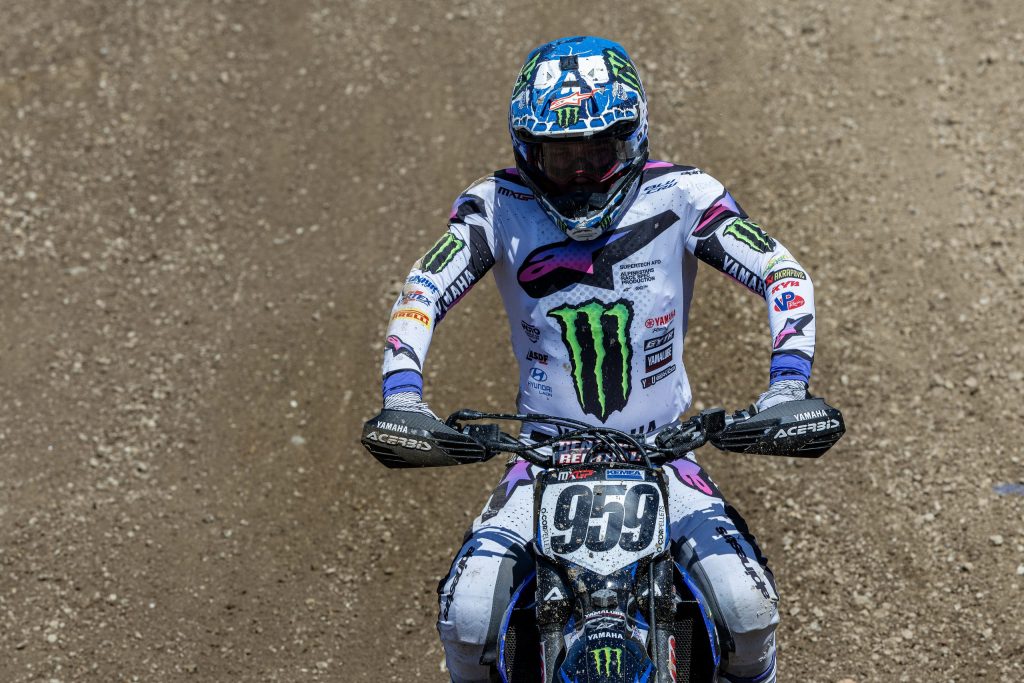
Maxime Renaux has been driving with the airbag system since this year, and as you can see here, he has already tested its function. / Photo: Ray Archer
Will the airbag become the new standard in motocross, like helmets, boots, or chest protectors? At least at the World Championship level, the FIM has now answered this question. Following the mandatory introduction this year... FRHHe-02-From 2028, riders in MXGP, MX2, WMX and the Motocross of Nations must wear a functioning airbag system on the track, as required by helmet regulations. Its use is already strongly recommended from 2027.
The decision was made by the Motocross Permanent Bureau, consisting of FIM President Jorge Viegas and Infront Moto Racing President David Luongo. This gives a development that has long since begun in the paddock a fixed date in the regulations for the first time.
An “urgent recommendation” initially allows drivers to retain the choice. A year later, this choice is gone.
Not every airbag will be permitted.
Just any airbag system under the jersey isn't sufficient. The FIM specifies which systems are permitted. Only airbags with the new FIM Offroad homologation are allowed. FRHPab-01 or systems that are deemed compliant by the FIM Category 3 for motocross were classified and listed accordingly.
The regulations also leave little room for interpretation regarding its use. The airbag must be worn and correctly closed during all activities on the track. The system must be functional at the start of each session. In case of doubt, the FIM Technical Director decides on the admissibility of the rider's equipment.
What does this mean for the drivers?
On paper, it's simple. In practice, the upcoming season is likely to be much more interesting.
Because in motocross, an airbag isn't just another protector you stuff under your jersey. Weight, freedom of movement, ventilation, and its combination with the rest of the protective gear all have to work for a rider who's constantly moving on the bike for 35 minutes.
Professionals are particularly sensitive about such things. Not necessarily because they don't care about safety, but because even small changes to their equipment can be disruptive. Anyone who feels restricted on the bike won't willingly embrace a system just because it promises more safety on paper.
The transition season gives drivers the opportunity to test different systems under race conditions. At the same time, it gives manufacturers time to further develop their products. When the mandatory racing season begins, the technology must function reliably in everyday racing situations.
This also puts pressure on equipment suppliers. All MXGP, MX2, and WMX riders, as well as the riders in the Nations, will then need an approved system that not only meets the regulations but can also withstand the demands of a complete race weekend.
The neck brace disappeared – is the airbag now taking over?
The FIM's decision is also interesting because rider protection has changed considerably in recent years. Neck braces were much more common in motocross for a while, but have now largely disappeared from professional racing.
Airbag systems now employ a different technology – and apparently, the areas of protection overlap more than one might initially assume. We asked Alpinestars whether their airbag system can help with neck injuries in addition to chest, back, and shoulder injuries. The manufacturer's answer is unequivocal:
"Yes, the system also helps prevent neck injuries. The airbag extends from the chest to the back and also covers the area around the neck and collarbone. When it inflates, it helps reduce neck movement in a fall."
This is particularly interesting in light of the development of neck braces. Limiting extreme head and neck movements during a fall has been one of the key arguments for these systems.
Alpinestars pursues a similar approach with its airbags, at least in part, but only at the moment of deployment. During normal riding, the rider doesn't wear a rigid structure between their helmet and upper body. If the system detects a fall, the airbag inflates, providing additional support for the upper body.
On its current product page, Alpinestars describes the Tech-Air MX as an electronically controlled system that automatically detects a crash and deploys within approximately 40 milliseconds. Officially, it lists airbag coverage for the chest, back, and shoulders.
Alpinestars takes things a step further with their Tech-Air Off-Road airbag, also designed for off-road use. The manufacturer explicitly names the neck and collarbone as protected areas and describes how the airbag inflates around the neck. Interestingly, according to Alpinestars, this system is not compatible with a neck brace.
Whether the airbag will actually replace the classic neck brace in motocross cannot yet be determined. However, the direction is clear. While the neck brace is worn permanently and its restraint is mechanically imposed, the airbag is designed to initially allow the rider as much freedom of movement as possible and only provide additional protection upon detection of a fall.
The upcoming season will show how well this principle performs under real racing conditions and whether the additional protection can be integrated in such a way that it is as unobtrusive as possible on the motorcycle.
A decision with consequences far beyond MXGP?
For now, the new regulation applies specifically to MXGP, MX2, WMX, and the Motocross of Nations. Therefore, there is no question yet of a general airbag requirement across all FIM motocross.
Nevertheless, the impact is likely to extend beyond the World Championship. If manufacturers base their entire factory equipment on airbag systems and top drivers compete with them week after week, the issue will inevitably reach national series as well.
The FIM did not specify with this decision whether a similar obligation would eventually follow there.
For the World Championship classes, however, the path is already set. By 2028 at the latest, it will become clear whether the systems have become so unobtrusive that the drivers forget about them after leaving the starting gate anyway – or whether the new requirement will still cause plenty of discussion in the paddock.